Rug the Horse, Not the Calendar
Updated: Sep 27

Why a temperature chart should be the starting point — not the final answer
Autumn can make rugging feel unnecessarily complicated.
You leave home in the morning and it's 6°C. By lunchtime it's 14°C. There's rain forecast, but perhaps only for an hour. The wind picks up. The sun comes out. And suddenly you're standing at the yard wondering whether the lightweight you put on at 7am was a sensible decision — or whether your horse is now quietly cooking underneath it.
Then there are the rugging charts.
They're useful. I use them too. But after many years of owning and caring for horses, I don't think any chart can tell you exactly what the horse standing in front of you needs.
Because temperature is only one part of the picture.
Start with the horse
Two horses standing in the same field on the same day can have very different needs.
One might be an unclipped, hardy type carrying a healthy covering, with a thick autumn coat, plenty of forage and good shelter.
The other might be finer, clipped, older, leaner or simply an individual who doesn't cope with cold and wet weather in quite the same way.
Putting the same rug on both because the forecast says 7°C doesn't necessarily make sense.
Current welfare guidance takes the same individual approach. Factors such as body condition, clipping, shelter, workload, housing, forage, wind and rain — as well as the individual horse's tolerance — can all affect rugging decisions.
That's why my starting point is simple:
Rug the horse, not the calendar.
Temperature charts are still useful
That doesn't mean I think rugging charts should be thrown away.
Quite the opposite.
A sensible temperature and rug-weight guide can give us a useful starting point, particularly when the seasons are changing and we're deciding between no rug, a lightweight or something warmer.
The problem comes when the chart becomes the decision rather than part of the decision.
If a chart suggests a lightweight at a particular temperature, I still want to know:
Is the horse clipped?
What sort of coat do they have?
What is their body condition like?
Is it dry, or is there persistent rain and wind?
Do they have shelter?
Do they have plenty of forage available?
Are they living out or spending much of the day stabled?
What will the weather be doing six hours from now?
And, most importantly, how is that particular horse actually feeling?
Horses have several natural ways of responding to colder conditions. Their coat provides insulation, eating forage generates heat, and horses at liberty can move around or seek shelter.
Cold combined with prolonged wind and rain can also feel very different from a still, dry day at exactly the same temperature.
Which is why the number on the weather app can never tell us the whole story.
Autumn is where it gets particularly awkward

For me, autumn is one of the trickiest times for rugging — not necessarily because it's particularly cold, but because it can be so changeable.
A chilly early morning can turn into a surprisingly warm afternoon.
Rain can arrive halfway through the day. The wind can change. A forecast can change completely from the one you checked the night before.
And unless you're lucky enough to be at the yard several times a day, you may have to make a decision in the morning that still needs to work reasonably well many hours later.
So rather than asking only:
“What rug does my horse need right now?”
I prefer to think:
“What conditions will my horse actually experience before I see them again?”
That small change in thinking can make rugging much more considered.
A piece of advice I've never forgotten
Years ago, a very experienced horsewoman friend gave me a piece of advice about rugging that has always stayed with me.
Her horses lived out 24/7 unless there was a particular reason for them to come in, and her approach was to err slightly on the lighter side rather than automatically reaching for the heavier rug.
Her reasoning was wonderfully practical.
Her horses had plenty of forage, room to move around and the opportunity to seek shelter. If they were a little cool, they could move, eat and generate heat naturally.
But if we'd wrapped them up too warmly, they couldn't exactly take their own rugs off.
Or, as I've come to think of it over the years:
Don't cook the horse.
It's simple advice, but the context of it matters.
I wouldn't automatically apply exactly the same approach to every horse.
A horse spending much of the day stabled, for example, is living in a very different environment from a horse turned out 24/7 with plenty of room to move, constant access to forage and suitable shelter.
Equally, a clipped horse, an older or leaner horse, a horse with particular health needs or one exposed to persistent cold rain and wind may need very different management.
And that's really the point.
Where and how the horse lives is part of the rugging decision too.
Turnout, stabling, movement, forage, shelter, wind and rain all change the conditions the horse is experiencing — before we've even considered their coat, clip, age, condition or individual tolerance.
So perhaps the lesson I've carried with me isn't simply “rug lighter.”
It's:
Don't assume that more rug is automatically better. Look at the whole horse and the whole environment first.
Put your hand under the rug
This is probably one of the simplest checks we can make — and one of the most useful.
Don't assume that because your horse's ears feel cool, they must be cold underneath their rug.
Put your hand beneath the rug, just behind the withers, and actually feel the horse.
You're looking for comfortably warm and dry — not hot, damp or sweaty.
And rather than relying on the ears, legs or face alone, feel across the neck, withers and body and consider what the whole horse is telling you.
Over time, this is also how we learn what is normal for our own horses.
One horse might be perfectly comfortable in conditions where another needs a little more protection.
That knowledge doesn't come from a chart.
It comes from checking.
More rug isn't automatically better
There's a very human temptation to look outside, feel cold ourselves and want to make our horses cosy.
But horses aren't people wearing fur coats.
Their winter coat provides natural insulation, and horses living out may also be able to move, eat forage and seek shelter as conditions change.
That doesn't mean leaving horses to be cold. It means recognising that the goal isn't to put as much rug on as we safely can.
The goal is to help the horse remain comfortable.
Sweating beneath the rug, hot or damp skin, increased breathing, lethargy or irritability and frequent rubbing can all be signs that a horse may be too warm.
At the other end of the scale, shivering, holding the tail tightly to the body, seeking shelter, increased movement or pacing and gradual weight loss can indicate that a horse may be struggling with the cold.
That's why checking the horse matters more than simply knowing which rug the chart told us to use.
Let the horse have the final say
I like practical guides.
I like having a reference point.
And when the weather is bouncing between temperatures from one day to the next, having somewhere sensible to begin can make life considerably easier.
That's exactly why I created Rugging Through Changeable Weather.
But I deliberately didn't want to create something that said:
X temperature = X rug. End of discussion.
Instead, the temperature guide is the beginning of the decision.
From there, we look at the horse — their coat, clip, condition, age and health — and their environment, including forage, shelter, turnout, stabling and the actual weather they're living in.
Then we check.
And we adjust.
Because good horse care isn't about following a chart perfectly.
It's about noticing the horse in front of us.
The chart is the starting point. Your horse is the guide.
A practical horse rugging guide for the yard
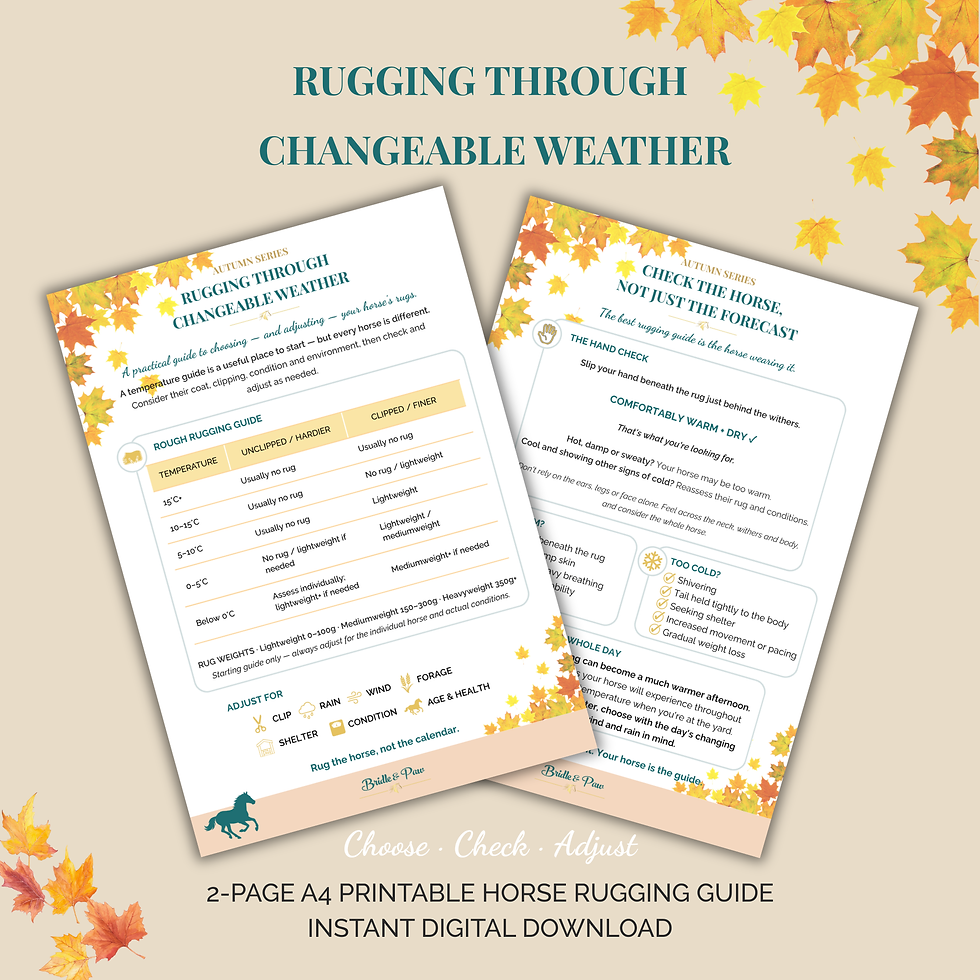
If you'd like something simple to keep at the yard, my Rugging Through Changeable Weather printable brings this approach together in a practical two-page reference.
It includes a rough temperature and rug-weight starting guide, factors that can change an individual horse's needs, the Hand Check, signs your horse may be too warm or cold, and guidance for those awkward days when the weather changes by the hour.
Choose · Check · Adjust.
And above all:

Comments